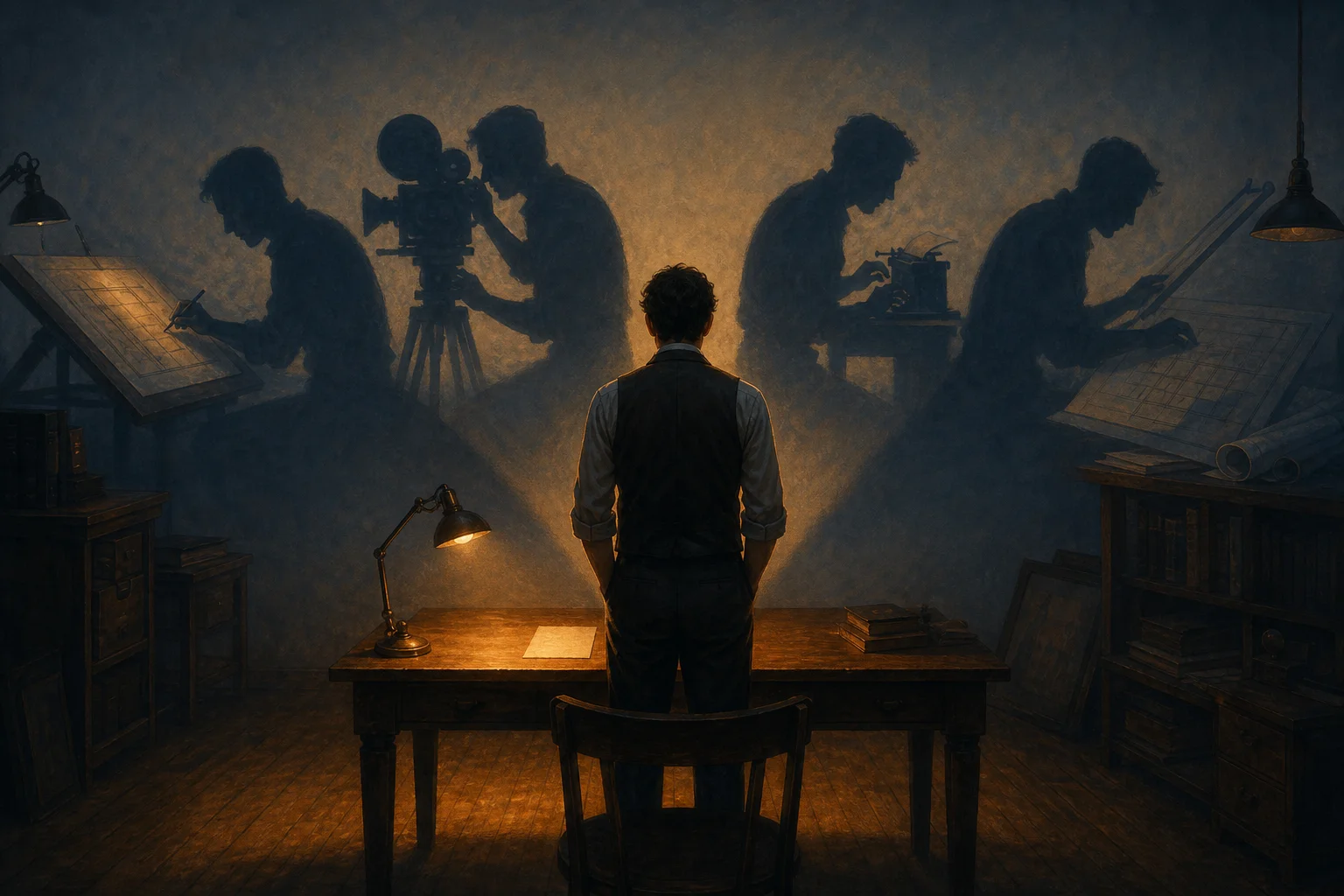
I built this story. I cast it, I directed every choice in it, and I stand behind the finished thing, top to bottom. I cannot copyright the sentence that came out of it, because I did not type it myself. That is not a complaint about being cock-blocked, but that’s exactly what it is. It is a description of a law that has no box to put what I actually did.
Copyright law asks one question of prose: who touched the keys. It was never built to ask who decided what the story actually is and who is accountable for what happens inside it, because until recently the answer to both questions was always the same person. Long-form fiction with a human directing an AI in the loop breaks that assumption. The law has not caught up.
The Spec Mismatch
The rule the U.S. Copyright Office and the courts are actually running is this: protection turns on human-authored expression, meaning the words on the page came from a human hand. Thaler v. Perlmutter, cert denied March 2, 2026, is the case everyone reaches for first, the one where Stephen Thaler ran an AI system he called the Creativity Machine, produced an image with it, and told the Copyright Office up front that no human had contributed anything to the result. The Supreme Court declined to hear the case, leaving the lower courts’ ruling standing. No human, no copyright.
That’s a clean answer. It is not a question anyone serious is actually asking about this piece. Thaler conceded zero human authorship before he ever filed.
That claim is also worth a second look, because nobody has verified it. Look at what is actually in the image: train tracks receding to a correct vanishing point through a coherent stone tunnel, framed by a specific flowering vine. Unconditioned noise does not resolve into architecture and correct perspective on its own. Something put those specific objects there, either a real photograph feeding the process somewhere upstream, or Thaler picking this result over whatever else the machine produced that day. “The machine did it with no human creative input” and “a human made zero decisions anywhere in the pipeline” are not the same claim. His filing only had to assert the first one, and nobody had to check the second.
I am not conceding either claim. I built the canon this story runs on, wrote the specification that constrains what the model is allowed to do inside it, and decided every arc, every chapter, and the specific sentence-level failures that get sent back for a rewrite.
I already made the underlying argument: authorship was never the keystrokes, it was the accountable sign-off behind them. This piece is not re-running that case. It is pointing that same standard at a body of law that has not caught up to it yet.
The obvious pushback: you did not type it, so you did not write it. That is what authorship has always meant. Fair, except the standard was never actually testing for typing. It was using typing as a stand-in for judgment, because until recently there was no way to separate the two.
Every human author who ever held a pen was also the one deciding what the sentence should say. AI-assisted work breaks the stand-in. It does not break the principle underneath it. Same test. New way to fail it.
Film settled a version of this argument decades ago, in the opposite direction from where copyright sits today. A screenwriter can write every line of a script, and the director’s name still goes above the title, “A Ridley Scott Film,” “A Steven Spielberg Picture.” The lead actor gets top billing on the poster for delivering those lines, sometimes for a scene they never wrote a word of, occasionally for one they improvised on the spot. Tom Cruise’s actual creative contribution to a screenplay is smaller than the screenwriter’s and smaller than the director’s, and his name is still the one that sells the ticket. Nobody in that industry pretends billing tracks who typed the words. It tracks who is accountable for what the audience actually experiences.
The money follows the same line, not the one you would expect. A working screenwriter earns a fraction of what the director and the lead actor take home on the same film, for writing every word those two get credited and paid to deliver. Nobody in that industry treats that as an accounting error. It is the compensation structure openly admitting what copyright has not: authorship was never the same job as producing the words.
Publishing has not had that conversation yet. Not for a manuscript where a machine did some of the typing.
Nobody has sued me over any of this. Nobody has sued me for anything, which either means I am doing something right or have not been caught doing something wrong yet. I have decided to call the silence due process for a question the Copyright Office has not answered, rather than a bill that comes due later. It is cheaper than a lawyer, and it lets me sleep.
Every Hat But One
Here is what actually happens before a chapter of Vampires of Tucson exists. I designed the Postgres schema that stores the canon: characters, locations, chapter beats, and the foreign keys that keep a vampire’s backstory from contradicting itself six books later. As of this week that schema tracks 125 named characters across 519 chapters, and the count only moves in one direction. Nobody built that for me. I am the database architect.
I wrote the prompt system that tells the model what a given chapter is allowed to do: whose voice it is rendering, what the location record says that place has become, which facts are locked and which are still open. That is not typing a request into a chat window. It is a specification document, 108,504 characters deep, built before a single scene gets drafted against it. I am the prompt engineer.
I built the outlines, the arcs, and the beat sheets that make eleven books hang together instead of drifting, and somebody decided who dies, who survives, what each character’s defining wound is, and exactly when the story is allowed to touch it. That somebody drew every one of those maps before the model wrote a sentence against any of them. I am the story architect.
I also cast it. Which of a hundred and twenty-five characters is on stage for a given chapter, who carries the scene, who has to be absent for the scene to work, that lives in its own table, separate from the outline, 1,204 rows and counting. Nobody else decides who walks into a room. I am the casting director.
I direct the cover art and the scene art, image by image: composition, palette, what the shot includes and what it leaves outside the frame, until the picture matches a character or a place I already built. I have never opened Photoshop for any of it. I have also never left one of those choices to chance. I am the art director.
I lay out the print and ebook files myself, in InDesign, page by page, the part of the job that has nothing to do with AI at all and everything to do with whether the finished object is actually a book someone can hold. I am the production designer.
Six hats, six jobs, six things nobody else did for me. The seventh hat has a name too: word picker, the one where fingers hit keys and a sentence appears on a screen. That is the only job I hand off, and I will say plainly why. I am not completely comfortable with my own ability to word pick, least of all at the fifty-thousand-word-and-up scale a novel actually runs at. I can edit. I just do not enjoy word picking.
It is also the only one copyright law currently checks for. Six out of seven. Nobody writes a spec around that ratio and calls it fraud.
Three Years, One With AI
This started two years before I ever put an AI model in the loop, just not in this shape. Characters got outlined in Word documents and PDFs. Reference images came from Adobe Stock Photos, picked by hand to match a face I had already decided on. Chapters got written the same way, one sentence at a time, in Word docx files with no schema underneath any of it. The system was analog. It was still mine.
The canon schema, the beat sheets in their current form, and the prompt architecture are newer than that. They showed up last year, the same year the model did, because I built both halves of the current pipeline together: the database that keeps 125 characters straight, and the tool that drafts sentences against it. The tool did not walk into a finished system. It walked into an upgrade I was already making.
This matters because the easiest attack on any AI-assisted writer is that the model did the work and the human just prompted it. I was casting characters and deciding what happens to them two years before any of that lived in a table, back when casting meant a stock photo instead of a database row. The tool arrived a year ago and the schema arrived with it. What did not arrive with it: two years of figuring out who these people are, done before a model ever touched a sentence of it. The tool is new. The judgment under it is not.
Confession, Not Ban
The platforms that actually host this kind of writing have already drawn a line the law has not gotten around to. Royal Road’s AI-text policy sorts fiction into tiers, no AI, AI-assisted, AI-generated, and asks authors to tag their work accordingly. It is a disclosure system, not a prohibition. Nobody gets banned for using the tool. They get asked to say so.
Amazon KDP’s content guidelines draw a sharper version of the same line. AI-generated content, meaning a model produced the text or images with no meaningful human hand in the final result, has to be disclosed. AI-assisted content, meaning a human wrote the thing and used AI tools to edit, refine, or brainstorm along the way, does not have to be disclosed at all. Amazon does not ask a human-directed manuscript to confess anything.
Neither test is actually asking who moved the fingers. KDP’s own line turns on whether a model produced the result with no meaningful human authorship, not on who typed it. Royal Road sorts the same way, by degree of human direction, not degree of human keystrokes. Two different platforms, one underlying question: who governed the constraints the words had to satisfy, and who decided what got kept. Word picking is not the test. Judgment is.
That still leaves a real middle open, and nobody has drawn a line through it. A writer who hands a model one paragraph of premise, with no schema or locked canon underneath it, and publishes what comes back with a light pass, does not obviously sort into either tier, and neither Amazon nor Royal Road has published a rule for that case. My workflow does not live in that middle. Not close. The specification and the schema this piece already laid out are not a light touch. They are the governing side of the same test these platforms are already running, whether the law has caught up to it or not.
That is the same distinction this piece is arguing the law has not formalized yet, already running quietly inside a platform’s terms of service. Publishing is not AI-hostile. It is AI-confessional, and the confession is only owed by the work that actually earns it. Mine does not. The reader still hands down the real verdict, one purchase and one review at a time, and that is a harsher and more honest court than any policy page will ever be.
The Gap Is Still Open
No U.S. court and no Copyright Office ruling has decided this specific fact pattern: long-form prose fiction, human-directed at every structural level, AI-assisted only in the drafting. Thaler answered a case where the human contributed nothing. That is a different fact pattern, not a different opinion about the same one.
The Copyright Office’s own 2025 report leaves the door open on purpose. It states plainly that AI-generated material inside a larger human-authored work does not automatically bar copyright, and that protection turns on whether a human contributed sufficient expressive elements. It also draws its own line: the mere provision of prompts does not clear that bar.
Fair. Nothing about what I do is mere prompting. A specification document 108,504 characters long and a locked canon schema tracking 125 characters are not a prompt. They are the job.
The Zarya of the Dawn letter is the closest thing to a precedent, and it cuts in my direction without quite reaching me. The Office split the work in half: the AI-generated panels did not qualify, the human-authored text and the human-arranged sequence did. That is a Copyright Office already comfortable separating what a person built from what a machine rendered inside the same object. Nobody has run that test on a full-length novel yet.
Allen v. Perlmutter is still open in federal court in Colorado, testing whether six hundred and some prompts and a lot of iterative direction add up to authorship on a single AI-generated image. That is the answer to the second objection before anyone raises it: if courts wanted to settle this, they would have settled it by now. They have not. The question is being actively litigated right now, on a single image. Prose has not gotten its turn yet.
The law will catch up to this eventually. I already built it. I am not waiting for permission to have done that.
— E.L. Frederick
All writing on this site contains elements of both human and AI produced material. This author uses all resources at his disposal.
← Back to Articles